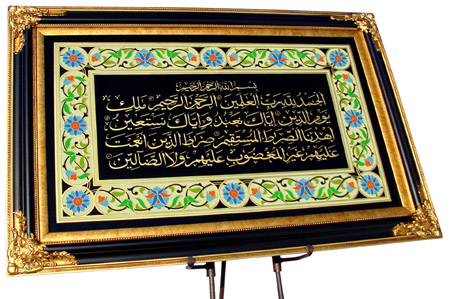
The Qur'an
Reading and understanding the Qur'an is an essential part of Islam, and also an excellent form of worship. However, simply reading an English (or whatever your local language may be) translation isn't enough, as the Qur'an should be recited in Arabic only, at least during prayers.
It is vitally important that each and every word is pronounced correctly, as the slightest error could give that word an entirely different meaning. An excellent example (or bad example, as the case may be) is the phrase "Assalamu Alaikum" (peace and blessings be upon you) that all Muslims should use to greet each other. However, omitting the first 'L' gives us "Assamu Alaikum", meaning 'death be upon you'.
By far the best way to learn how to recite the Qur'an properly is to learn how to read Arabic. There are plenty of transliterated (converted to the Roman alphabet) versions of Islamic texts available which are undoubtedly helpful for beginners like myself. However, there are certain letters in the Arabic language that cannot be easily transliterated
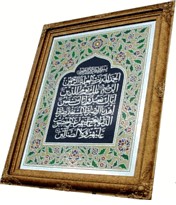
The Arabic letter 'ghain' (right) is one such example. It is often written as 'gh', as in Maghrib, but when correctly pronounced it is not a simple 'g' sound, but rather an almost silent sound like the 'gh' in 'aargh' (this is very difficult for me to describe properly, you really would need to listen to this for yourself).
Learning to read Arabic isn't really as difficult as it sounds. Once you learn each of the different letters (some of which sound very similar), along with the three basic vowel sounds and a few punctuation marks, reading and learning the Qur'an becomes a lot easier (I find that this is because you are able to visualise the words, simply because they are written in a distinctive alphabet). Your local mosque may hold Arabic lessons, or at least be able to tell you where you can learn.
I have added a guide to Basic Arabic to this site, which gives a brief outline of the letters and numbers of the Arabic alphabet along with some common punctuation marks.
When it comes to memorising the Qur'an, I find it easiest to learn one ayat a day, and taking time out during the day to recite it in order to commit it to memory. This is best done whilst taking a walk - you can just keep repeating the ayat in your head over and over again until you are sure you have it right.
You can also learn a surat by printing the transliterated text out, laying the printed page at the end of your sajada (prayer mat) and including as part of your prayer. This is easily done using Divine Islam's Holy Qur'an Viewer.
Your pronunciation of the Qur'an can be checked by asking a friend to help you, by listening and copying a recitation of the Qur'an on tape, CD or CD-ROM, by listening to the way the Imam at your local mosque leads the prayer, or by attending Qur'an lessons at your mosque. I would recommend using all of these options if possible (this obviously depends on how close you live to a mosque).
Recordings of the Qur'an on tapes, CDs and CD-ROMs are often recited by someone whose reading is so beautiful that simply listening to it can bring tears to your eyes, and it also allows you the convenience of practising in the comfort of your own home. Unfortunately, nobody has yet to invent a CD-player that can correct you if you make a mistake!
Other Islamic Texts
There are a lot of Islamic publications available to you, some of which will be more useful to you than others.
The best of these are Sahih Al-Bukhari, Sahih Muslim, and other books which contain the Sunnah and Hadiths. Apart from the Qur'an, these form the basis of many Islamic laws and practices such as prayer, fasting, marriage and trade. You can access these and other hadith collections by downloading Islamasoft's Hadith Software.
There are a whole host of other publications covering just about every aspect of Islam in the form of books, leaflets and web pages. My advice to any new Muslims would be to just stick to those covering basic topics, for example Tawheed (the Oneness of Allah), prayer and the history of Islam (especially the time of Muhammad, peace and blessing be upon him). Publications covering more advanced topics such as the finer points of Islamic law or practice would merely cause confusion and are best left alone until you become more familiar with Islam as a whole.
Recommended Reading
- The Qur'an
- There are a number of different English translations available. One that I would recommend is Muhammad Al-Hilali and Muhsin Khan's translation, as they tend to use clear English and often elaborate any points that need explaining with the use of selected hadiths (although they can overdo this on occasions, resulting in some ayats being difficult to follow). When you become confident in reading Arabic and you wish to begin memorising surats from original Arabic text, I would recommend using Dar-Al-Maarifah's Tagweed Qur'an, which uses colour-coding to emphasise certain letters and sounds. For example, red is used for long-sounded letters (i.e. Alif Laam Miim - Surat Al-Baqarah 2:1), and light blue for two letters combined.
- Dictionary of the Qur'an
- (PDF (1.52 MB) - right-click on link and select 'Save As...', or left-click to open in new window)
A complete listing of every Arabic word which appears in the Qur'an, along with every possible English definition. I originally found this on another site which has since gone out of existance, which is why I am now hosting on my own webspace, as this is a far too valuable resource to lose.
- Sahih Al-Bukhari
- Out of all the hadith collections available, Sahih Al-Bukhari is often regarded as the being the best.
- 'Islam in Focus' (by Hamudah Abdalati)
- Basically a beginners guide to Islam - this is very suitable for new Muslims and non-Muslims who are looking to learn more about Islam. It explains the basic aspects of Islam fully and clearly, and how it relates to everyday life. In the words of the author, "...the book represents Islam as a universal, viable, resourceful and cosmopolitan religion that is not only relevant to every phase of human existence, but also necessary for the very well-being of mankind".
- 'The Fundamentals of Tawheed' (by Abu Aminah Bilal Phillips)
- This book explains the science of Tawheed, or worshipping Allah alone without any partners. It also explains Shirk (associating partners or equals with Allah), and how it has invaded many religions and everyday practices. Highly recommended.
- Harun Yahya
- A special mention has to go to this very popular author who has written some amazing books about Islam, all of which can be downloaded from his website. Highly recommended books include:
Negative Influences
Publications promoting violence or hatred towards a particular group (whether it is another Muslim sect, another religion or another country) will either sow seeds of hatred within you and divert you from the true teachings of Islam, or drive you away from Islam altogether.
Unfortunately, this is becoming more and more common. All decent Muslims must remain vigilant and wary of those who try to spread this kind of hatred - they usually do this by handing out leaflets outside mosques or at university Islamic Societies. If this happens at your mosque, it may be worth mentioning this to the Imam as he may be able to put a stop to it, or at least speak out against it. Just remember that no matter how compelling their arguments may sound, Islam neither preaches nor condones bigotry, hatred or common violence of any sort.
Anti-Islamic Websites
Another form of publication you may come across are anti-Islamic websites - some of these attempt to disprove Islam through 'intellectual' means, whilst others openly preach hatred towards Muslims. Some of the things written on these pages can be quite disturbing and have indeed poisoned many people's opinions about Islam, especially since the horrible events of September 11th 2001.
Usually, these pages will quote ayats from the Qur'an or hadiths in an effort to portray Islam as a violent, intolerant religion. In order to fit that author's agenda, these quotes will be written incomplete, or their translations will have been twisted or distorted.
What you need to bear in mind is that these pages use ayats without considering the content of the remainder of that surah, or the historical context in which it was revealed. For example, the Qur'an contains verses referring to war and killing, which often form the basis of these misconceptions. BUT, rather than ordering each and every Muslim to go out and attack every 'infidel' they can find, these verses were revealed during wartime, and further reading will tell you that they are telling Muslims how to conduct themselves in battle (for example, not to betray your fellow Muslims or consort with the enemy, to accept all calls for peace, not to kill innocent civilians or damage their property, etc.).
If you come across such a page, whatever you do, don't give the author any kind of feedback. The only reason they are doing this is to get attention - the less he gets, the less successful his cause will be. Likewise, if you come across such a bigot on a message board or chatroom, don't get into a religious debate with him - it will be a complete waste of time, and you could very well end up doubting your own faith.
I have recently come across a number of very good pages which were set up specifically to combat the lies spread by anti-Islamic pages, the best of which are Answering-Christianity.com, Bismikaallahuma.org and Faithfreedom.com.
Return to Top - © Amir Brooks - 2006 / 1427